When a child spends time with a parent or family member under supervision, professionals may need an accurate record of what happened during the session. A supervised contact report can provide this record, helping those involved understand the quality of interactions, the child’s responses and any relevant safeguarding concerns.
For local authorities, solicitors, children’s guardians and other professionals, these reports can be an important source of information when reviewing family contact arrangements. They may also help identify positive developments, areas where additional support could be beneficial and questions that need further consideration.
However, a supervised contact report is not simply a summary of a visit. It should be factual, balanced and focused on relevant observations rather than assumptions about a parent’s intentions or conclusions that cannot be supported by the evidence.
This guide explains what supervised contact reports usually include, how they may be used in family cases and what professionals should consider when arranging supervised contact.
A supervised contact report is a written record of a contact session between a child and a parent, relative or another person, where a professional is present to supervise or support the interaction.
The report is generally prepared by the person responsible for observing the session, in accordance with the agreed arrangements and reporting requirements.
Depending on the purpose of the contact, the report may record:
The precise content depends on the circumstances, the purpose of the contact and the instructions given to the provider.
A report should distinguish between what the supervisor directly observed, what someone else reported and any professional interpretation that falls within the supervisor’s role.
Supervised contact may be arranged when a child needs additional safeguards or support during time spent with a parent or another family member.
The reasons vary. There may be concerns about a child’s safety, difficulties between adults, a need to rebuild relationships or a requirement for professional oversight while contact arrangements are being reviewed.
A report can help provide a clearer picture of what happens during contact rather than relying entirely on recollections or differing accounts from those involved.
Reports may help professionals:
A report is one source of information, not a complete assessment of the parent’s overall parenting capacity or the child’s relationship with that parent.
A useful report should be clear, structured and relevant to the purpose of the session.
The report should identify the session being recorded.
This may include:
These details help professionals establish the context in which the observations were made.
The report may describe the child’s observable presentation at the beginning of the session, during contact and at the end.
For example, the supervisor might record whether the child approached the parent, engaged in an activity, sought reassurance or appeared reluctant to participate.
Descriptions should be specific and objective. Rather than stating that a child was definitively happy, frightened or distressed without sufficient evidence, the report should describe the behaviour observed and any relevant words spoken by the child.
A child’s behaviour can have different explanations. A single observation should not automatically be treated as proof of a particular feeling or view.
The report may record how the parent and child interacted during the session.
Relevant observations could include whether the parent:
The report should give concrete examples where possible. Specific observations are generally more useful than broad descriptions such as “good contact” or “poor parenting”.
A report may describe the activities undertaken and how the parent and child engaged with one another.
Depending on the child’s age and the purpose of the session, this could involve play, conversation, reading, eating together or another planned activity.
The report may also record relevant verbal and non-verbal communication, including how the parent responded when the child initiated interaction or needed help.
The focus should remain on observations that are relevant to the agreed purpose of contact.
Some sessions require the supervisor to provide reminders, guidance or practical support.
For example, the supervisor may need to remind an adult about an agreed boundary, help manage a difficult transition or support the child when they become unsettled.
The report should record relevant interventions and the responses that followed. This helps professionals understand not only what occurred but also the circumstances in which the interaction took place.
Where no intervention was required, that may also be relevant to the record.
Any relevant safeguarding concern should be documented accurately and handled in accordance with the applicable safeguarding procedures.
The report may record what happened, who was present, what was said or observed, what action the supervisor took and who was informed.
Where an incident requires immediate action, the supervisor should follow the relevant safeguarding and escalation procedures rather than relying solely on the written report.
The report should avoid speculation and should not make allegations appear established when they have not been verified.
The report may conclude with a concise summary of the session and any relevant matters that require follow-up.
This might include whether the session took place as planned, whether support was needed, whether a concern was raised and whether the supervisor communicated any issue to the appropriate professional.
Any recommendations or opinions should remain within the scope of the supervisor’s role and the instructions received.
In family cases, supervised contact reports may be shared with relevant professionals to help them understand how contact sessions have progressed.
Depending on the circumstances and the arrangements in place, reports may inform discussions about:
Where a case is before the family court, the report’s status and the way it can be relied upon depend on the circumstances, the purpose for which it was prepared and any applicable court directions.
A contact report should not automatically be described as formal expert evidence. A factual record prepared by a contact supervisor is not necessarily equivalent to an expert assessment of parenting capacity.
The court makes decisions within the applicable legal framework and considers the relevant evidence as a whole. A supervised contact report is one potential source of information and does not determine the outcome of proceedings by itself.
Professionals should clarify the purpose of the report and any requirements concerning its preparation, disclosure and use.
The terms can be used differently depending on the service and the arrangements for an individual family.
Supervised contact generally involves a professional overseeing the session to help maintain the agreed safeguards and observe the interaction.
The level of supervision depends on the identified concerns and the arrangements in place.
Supported contact may involve a professional providing a guiding presence or practical assistance without the same level of continuous oversight required for supervised sessions.
The appropriate arrangement depends on the child’s needs, the relevant risks and the instructions from those responsible for the case.
Neither term should be used as a substitute for clearly defining the purpose, boundaries and responsibilities of the contact arrangement.
Family Safeguarding Assessments provides both supervised and supported contact services, with arrangements considered in the context of each family’s circumstances.
The quality of a report depends partly on how clearly the contact arrangement and reporting expectations are established.
Local authorities, solicitors and other referring professionals can help by addressing several points before sessions begin.
Explain why contact is being supervised and what the supervisor needs to observe or record.
Objectives should be relevant to the child’s needs and the identified concerns. They should not require the supervisor to reach conclusions outside their role.
Clarify whether a report is expected after each session, what information it should contain and who should receive it.
Where a particular format or deadline is required, this should be discussed before contact begins.
The provider should receive information necessary to plan the sessions safely and appropriately.
Depending on the case, this may include the contact arrangements, relevant safeguarding concerns, known triggers, communication needs and practical information about the child.
Information sharing should be proportionate and consistent with applicable confidentiality and data protection requirements.
Reports should describe what the supervisor observed, including relevant examples.
They should distinguish observations from information provided by other people and avoid unsupported conclusions about a person’s motives, emotions or overall parenting ability.
A single session provides a limited snapshot. Repeated reports may help professionals identify patterns, changes or recurring concerns over time.
However, patterns should be considered in context, including the child’s age, individual needs, the setting and any support provided during contact.
The provider and referring professionals should be clear about how concerns are escalated, who needs to be notified and what action is required if a child’s safety may be at risk.
Reporting is important, but it does not replace the need to respond appropriately to an immediate concern.
A report may record observations that are relevant when professionals review contact arrangements. Depending on the supervisor’s role and the instructions received, it may also identify matters that warrant further consideration.
For example, repeated difficulties with transitions or a need for frequent intervention may indicate that the arrangements should be reviewed by the responsible professionals.
Similarly, reports may document positive interactions or progress that can inform a wider review.
However, a supervisor should not assume they have authority to change a court-ordered arrangement or make decisions that belong to the court or responsible professionals.
Any proposed change should be considered through the appropriate process, taking account of the child’s welfare, relevant evidence and applicable directions.
Parents may feel anxious about being observed during contact, particularly when family proceedings or safeguarding concerns are involved.
The arrangements should be explained clearly so that the parent understands the purpose of supervision, the role of the supervisor and any boundaries that apply.
Depending on the agreed arrangements, parents can generally expect the supervisor to observe and record relevant aspects of the session, provide guidance where necessary and follow safeguarding procedures.
It may help parents to focus on their child’s needs, engage in age-appropriate activities, follow agreed boundaries and ask for clarification if they do not understand an instruction.
Parents who have concerns about the arrangements or how a report may be used should seek advice from the relevant professional or their legal representative.
A supervised contact session is not, by itself, a comprehensive parenting assessment. The observations should be understood within the limits of the session and the purpose for which supervision was arranged.
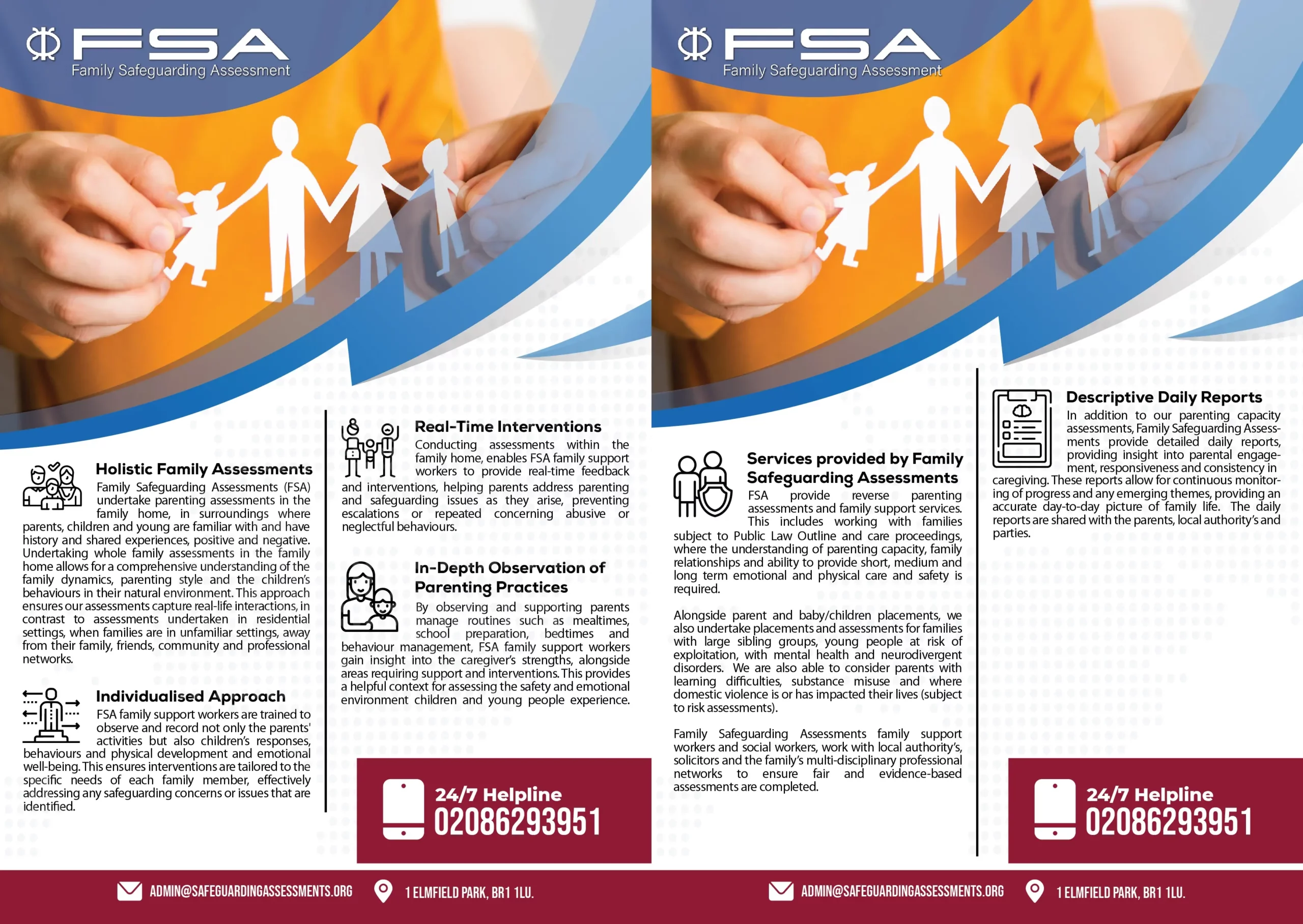
Family Safeguarding Assessments (FSA) provides supervised contact services for families and professionals who need structured, child-focused arrangements.
The service includes supervised contact sessions, supported contact, handover support and contact in appropriate community or venue-based settings.
Where requested, Family Support Workers prepare factual reports recording relevant observations, interactions, engagement and concerns arising during sessions. Reporting arrangements can be discussed as part of the referral process.
FSA works with local authorities, solicitors and families to clarify the purpose of contact, relevant safeguarding information, practical arrangements and reporting requirements.
To discuss a referral, visit the Family Safeguarding Assessments website.
A report may include session details, attendance, observations of parent-child interaction, the child’s observable responses, any support provided by the supervisor and relevant safeguarding concerns. The content depends on the purpose and arrangements of the contact.
They may be shared with relevant professionals and may form part of the information considered in family proceedings, depending on the circumstances and applicable directions. A contact report is not automatically formal expert evidence.
Not necessarily. It records observations within the scope of the contact session. A full parenting capacity assessment is a different process and may require broader evidence and assessment activities.
A supervisor should follow the agreed safeguarding and escalation procedures if a serious concern arises. Their authority to take action depends on the arrangements and instructions in place. Decisions about longer-term contact arrangements should be made by the appropriate professionals or court, as applicable.
This depends on the service agreement, referral requirements and purpose of contact. Reports may be requested after individual sessions, but the frequency and format should be agreed before the service begins.
The supervisor should follow the relevant safeguarding procedures and take any immediate action required to protect the child. The incident should be documented accurately and communicated to the appropriate people in accordance with the agreed arrangements and applicable procedures.
It may be considered where the child’s circumstances, relevant evidence and professional decisions support a change. Progression is not automatic and must follow any applicable court directions and safeguarding arrangements.
Depending on the service, referrals may come from local authorities, solicitors, other professionals or parents seeking a service directly. The provider should clarify the referral requirements and ensure the arrangements are suitable for the family’s circumstances.
Supervised contact reports can help professionals maintain a clear record of family contact, including relevant interactions, positive developments and safeguarding concerns.
Their value depends on accurate observation, factual writing and a clear understanding of the supervisor’s role. Reports should be considered alongside other relevant information and should not be treated as a complete assessment of parenting capacity or as a decision about a child’s future arrangements.
For professionals arranging supervised contact, clear objectives, appropriate safeguarding information and agreed reporting requirements can help ensure that sessions are purposeful and that the resulting records are useful.
Family Safeguarding Assessments works with families and professionals to arrange child-focused supervised and supported contact.
Visit FSA’s supervised contact service page to discuss the arrangements and reporting requirements for your case.
At Family Safeguarding Assessments (FSA), we understand the importance of keeping families together while ensuring the safety and well-being of children