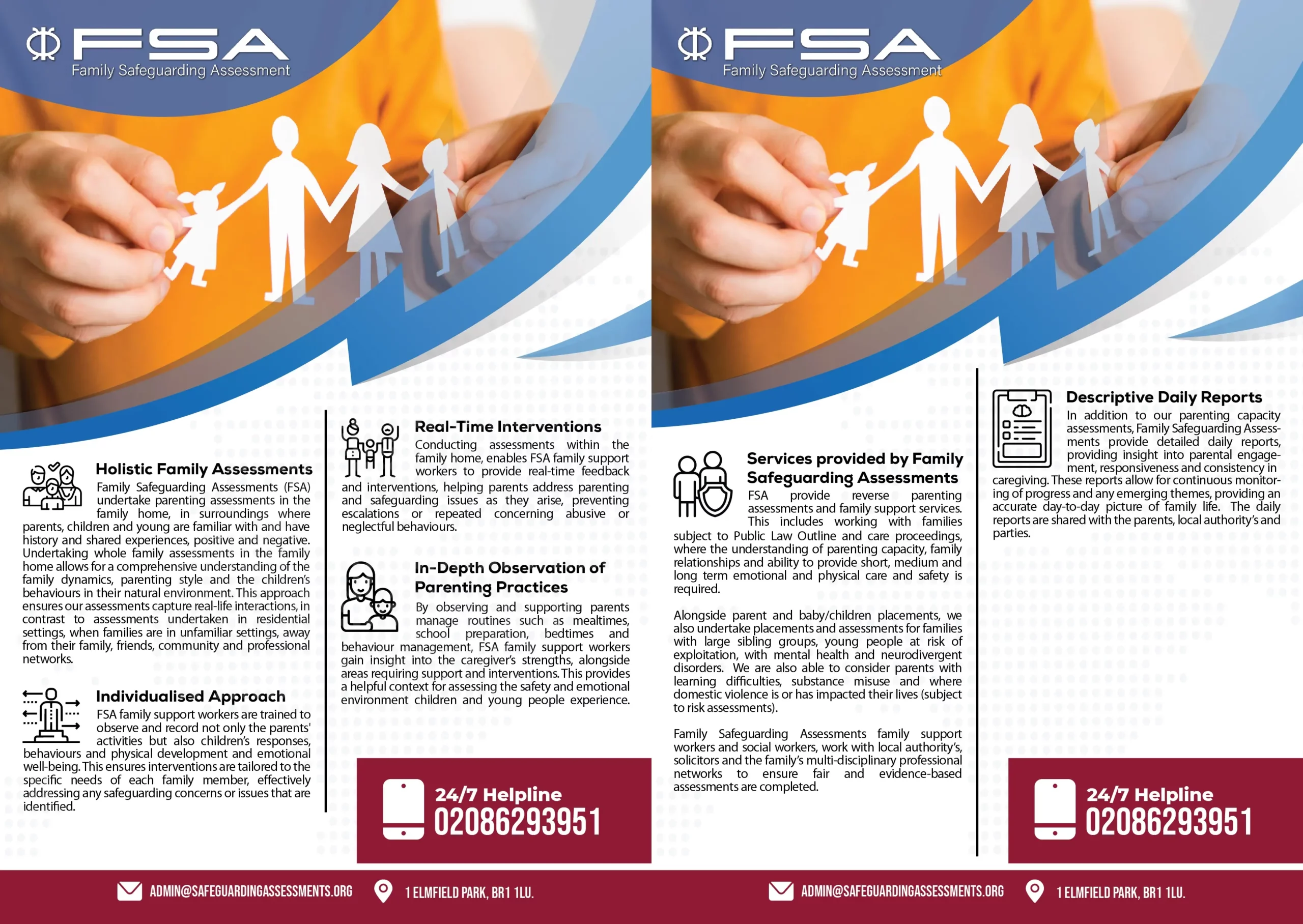
A reverse parenting assessment allows a family to be assessed within their own home and community, rather than removed to a residential assessment centre. At Family Safeguarding Assessments (FSA), our reverse parenting assessments combine the rigour required for court and local authority decision-making with the practical benefit of observing a family in the environment where they actually live.
A reverse parenting assessment sometimes referred to as a reverse residential parenting assessment or reverse residential assessment reverses the traditional model of sending a family to live in a residential unit for assessment. Instead, our Family Support Workers (FSWs) and Independent Social Workers (ISWs) come to the family, carrying out observation, support, and assessment work in the family’s own home over a sustained period.
This approach is available for reverse parenting assessments UK-wide, wherever FSA operates across London, the South East, the South West, and the East and West Midlands, and is particularly valuable where removing a family from their existing support network and routine would itself be disruptive or counter-productive.


As a home based parenting assessment, our model is built around minimising disruption. Conducting a parenting assessment at home allows children to continue attending their usual school, keep up existing routines, and stay connected to family, friends, and their local community throughout the assessment period.
We describe this as a community parenting assessment because it keeps the family embedded in their existing support systems rather than isolating them. For local authorities and courts weighing up options, this makes reverse parenting assessment a genuine alternative to residential parenting assessment — one that still produces robust, court-ready findings, but without the cost, disruption, and separation that a residential placement involves.
Our parent and child assessment at home covers the full range of everyday interactions: feeding, play, routines, boundary-setting, and how parents respond under the ordinary pressures of daily life — insight that is far harder to capture accurately in an artificial residential setting.
Where required, FSA provides a 24 hour parenting assessment model, with Family Support Workers available around the clock to observe, support, and where necessary intervene. A 24 hour family assessment at home gives referrers confidence that safeguarding is continuous throughout the assessment window, not limited to scheduled visits.


FSA works with local authorities, solicitors, children’s guardians, and other professionals involved in family law proceedings. We accept:
Instructions as a parenting assessment provider for solicitors, including preparing evidence for contested hearings
We also recognise that some situations cannot wait for a standard timetable. FSA considers urgent parenting assessment referrals and emergency parenting assessments, and our Consultant Social Worker aims to confirm availability within one working day of receiving an expression of interest.
Where a case proceeds to a contested hearing, our Independent Social Workers are experienced in providing expert parenting assessment evidence for family court, having prepared and defended findings in both public and private law proceedings.
Every reverse parenting assessment is led by an experienced, registered independent social worker. Our ISWs bring direct experience of court-directed assessments and are supported by our Consultant Social Worker, who has over 25 years’ experience in safeguarding, child protection, and looked-after children’s services, including as a former CAFCASS children’s guardian.

Our assessments are informed by recognised, evidence-based frameworks, including ParentAssess and the Cubas model of parenting assessment. Depending on the Letter of Instruction from the referring party, we can adapt between a simplified assessment and a fully comprehensive one, ensuring the approach fits the specific concerns and timescale of each case.
FSA’s Family Support Workers and Independent Social Workers are trained and experienced in assessing families across a wide range of circumstances, including:
Supporting parents with learning difficulties, adapting communication and assessment methods appropriately without compromising the rigour of the findings.
Assessing families where domestic abuse or coercive control has been a feature, with FSWs trained in recognising and responding to these dynamics safely.
Working with families where substance misuse is a concern, alongside relevant support services where appropriate.
Assessing parenting capacity where parental or child mental health is a factor, in coordination with the family’s wider professional network.
Every reverse parenting assessment includes a structured risk analysis, identifying safeguarding concerns alongside the family’s existing strengths and protective factors, to support balanced, evidence-based recommendations.
Parents are referred by social services, legal representatives, or other concerned agencies. Our Consultant Social Worker reviews the available papers and confirms availability, typically within one working day.
A planning meeting is held with the social work team and other relevant professionals, followed by a home visit to meet the family, discuss privacy and consent, and answer questions.
FSWs carry out daily observations and provide supervision where required, while ISWs lead structured parenting capacity work using tools such as ParentAssess. Two daily reports are shared with parents to promote transparency and support engagement.
Findings are drawn together into a clear risk analysis, identifying both concerns and protective factors, with recommendations discussed openly with the family and referrer.
Where appropriate, FSA can provide continued monitoring and support following the assessment, coordinated between the Local Authority, FSA, and the family.
A residential parenting assessment requires a family to live in a dedicated residential unit for the assessment period. A reverse parenting assessment brings the assessment to the family’s own home instead, allowing children to maintain their normal routines while still producing thorough, court-ready findings.
Our Consultant Social Worker aims to confirm availability within one working day of receiving a referral, and we do accept urgent and emergency referrals where timescales are tight.
Referrals typically come from local authorities, solicitors, and children’s guardians involved in public law outline or family law care proceedings.
Yes. Our Independent Social Workers are experienced in preparing reports and providing expert evidence in both public and private law proceedings.
To discuss a referral, contact us or call 02086293951.
At Family Safeguarding Assessments (FSA), we understand the importance of keeping families together while ensuring the safety and well-being of children