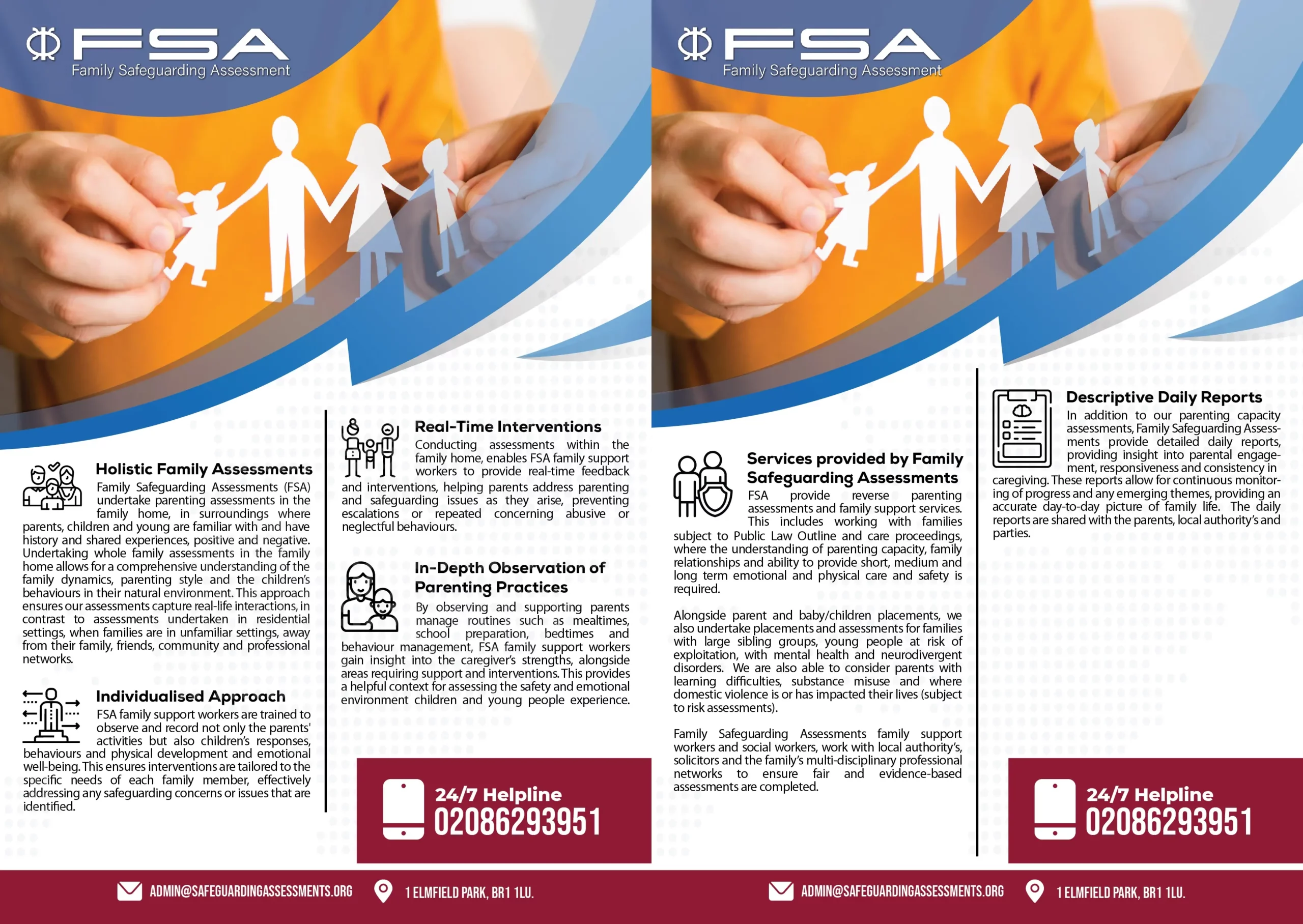
Family Safeguarding Assessments (FSA) provides parenting assessment services to help local authorities, solicitors and other professionals understand a parent’s ability to meet their child’s needs and provide safe, consistent care.
Our approach focuses on the individual circumstances of each family, considering parenting strengths, safeguarding concerns, practical care and the potential for positive change.
We understand the importance of clear, evidence-informed assessments when professionals are making decisions about children’s welfare, family support and future care arrangements.
Whether you require an independent parenting assessment or a more specialised home-based assessment, our team can discuss your referral requirements and the appropriate next steps.
To discuss an assessment referral, contact Family Safeguarding Assessments.
A parenting capacity assessment examines a parent’s ability to meet their child’s needs, provide appropriate care and respond to relevant safeguarding concerns.
The assessment considers the child’s circumstances alongside the parent’s understanding, practical parenting abilities, support needs and capacity to make and maintain changes where necessary.
The precise scope depends on the referral questions, the child’s needs and any relevant court directions.
For a broader explanation of how assessments contribute to family proceedings, read our guide to parenting assessments and family court.

The referring professional outlines the reasons for the assessment, the key questions and any relevant deadlines. This information helps establish the proposed scope of work.
Relevant records, previous assessments and other available information may be reviewed to understand the family's circumstances and the concerns that need to be explored.
For guidance on preparing a referral, see what information is needed for a parenting assessment referral.
Depending on the agreed assessment plan, the work may include discussions with the parent, direct observation of parenting, consideration of family routines and information from relevant professionals.
The findings are brought together to address the referral questions. The report may identify strengths, areas of concern, safeguarding considerations and recommendations supported by the assessment findings.
For more information, read our guide to what a parenting assessment report tells the family court.

Different families require different assessment approaches. FSA offers related services for particular circumstances and assessment needs.
A home-based assessment may be appropriate where the referral requires parenting to be considered within the family’s everyday environment.
Explore our Reverse Parenting Assessment service to learn more about this specialist assessment approach.
Where pregnancy, early parenthood or perinatal circumstances are relevant to the assessment, specialist consideration of the parent’s circumstances and the baby’s needs may be required.
Learn more about our perinatal assessment services.
Where a family requires professionally supervised contact arrangements, this is a separate service from a parenting capacity assessment.
Find out more about contact supervision with family support workers.
The appropriate service depends on the family’s circumstances, the referral questions and the arrangements required by the relevant professionals.
Our assessment services may be relevant to professionals seeking information about parenting capacity and children’s needs, including:
Where an assessment relates to court proceedings, the referring professional should clarify its purpose and evidential status. A parenting assessment is not automatically formal expert evidence; applicable court rules and directions must be followed.
For further information, read why the family court might request a parenting assessment.


Family Safeguarding Assessments works with professionals involved in family safeguarding and assessment. The appropriate assessor, methods and arrangements depend on the requirements of the individual referral.
Our approach aims to provide clear, balanced and evidence-informed findings that address the questions raised and keep the child’s needs central.
To learn more about the role of independent social workers in parenting assessments, read Independent Social Worker Parenting Assessments: What Do They Involve?.
If your organisation requires a parenting capacity assessment, contact Family Safeguarding Assessments to discuss the referral, the questions to be addressed and any relevant timescales.
Providing the available background information, safeguarding concerns and applicable court directions can help clarify the requirements of the proposed assessment.
Contact Family Safeguarding Assessments to discuss your referral.

It examines a parent’s ability to meet their child’s needs, identifies relevant strengths and concerns, and provides findings that may inform safeguarding and care-planning decisions.
Local authorities, solicitors and other professionals involved in safeguarding or family proceedings may seek an assessment, depending on the circumstances and commissioning arrangements.
The assessment setting depends on the referral requirements. FSA also offers a dedicated Reverse Parenting Assessment service for relevant home-based assessment needs.
Timescales vary according to the complexity of the case, the assessment methods required, the availability of information and any applicable court timetable. The expected timescale should be discussed when the referral is considered.
An assessment may inform family proceedings, depending on how it was commissioned and its intended purpose. Formal expert evidence is subject to the applicable court rules, directions and permission requirements.
The findings may inform professional discussions, safeguarding decisions and care planning. Read more about what happens after a parenting assessment is completed.
For information about parenting capacity assessments and related services, visit Family Safeguarding Assessments to discuss your requirements and the appropriate next steps.
At Family Safeguarding Assessments (FSA), we understand the importance of keeping families together while ensuring the safety and well-being of children