If you are a solicitor, local authority, children’s guardian or other professional looking to arrange an independent parenting assessment, one of the first questions is likely to be: how much will it cost?
There is no single price that applies to every parenting assessment. The cost can vary significantly depending on the type of assessment required, the complexity of the family circumstances, the amount of observation involved, the location, the timescale and the level of professional input needed.
A short, straightforward assessment will not necessarily require the same resources as a complex assessment involving sustained observation, safeguarding concerns, multiple children or an urgent court timetable.
For this reason, a reputable parenting assessment provider should consider the individual referral before confirming the appropriate fee.
The cost of an independent parenting assessment depends on what the assessment needs to achieve.
An assessment may involve a qualified social worker reviewing documents, meeting parents, observing parent-child interactions, liaising with professionals and preparing a detailed report.
Other assessments may require more extensive observation and support, particularly where the assessment is carried out within the family home over a sustained period. In such cases, a reverse parenting assessment may be an appropriate option, depending on the family’s circumstances and the referral requirements.
The provider should therefore establish the scope of the referral before providing a final quotation.
When requesting a quote, it can be useful to provide:
Providing this information at the beginning can help the provider understand the work involved and give a more meaningful quotation.
There are several reasons why the cost of an independent parenting assessment can differ from one case to another.
Different assessments require different levels of professional involvement.
For example, a standard parenting capacity assessment may involve a defined number of meetings and observations, while a reverse parenting assessment may involve sustained observation and support within the family’s home.
A perinatal parenting assessment may also require a different approach because it can involve assessment before birth or during the early stages of a baby’s life.
The assessment type should therefore be agreed before a fee is confirmed.
Some referrals involve relatively straightforward questions about parenting capacity.
Others may involve several areas of concern, such as:
Where the assessment requires more extensive professional analysis, observation or liaison with other professionals, the overall work involved may increase.
Observation can be an important part of a parenting assessment.
The assessor may need to observe how a parent responds to a child’s needs, manages routines, provides supervision, communicates with the child and responds to difficult situations.
A more extensive assessment involving sustained observation naturally requires more professional time than an assessment based on a smaller amount of direct observation.
The appropriate level of observation should be determined by the questions the assessment needs to answer rather than by using the same approach for every family.
Where professionals also need information about parent-child interactions during arranged visits, supervised contact services may be relevant as a separate service. Supervised contact does not replace a parenting capacity assessment.
A home-based assessment can involve a different level of professional input from a shorter assessment carried out through scheduled appointments.
However, it is not appropriate to assume that a home-based assessment will always cost more or less than a residential assessment.
The actual cost depends on the structure of the assessment, its duration, staffing requirements, location and the level of observation and support required.
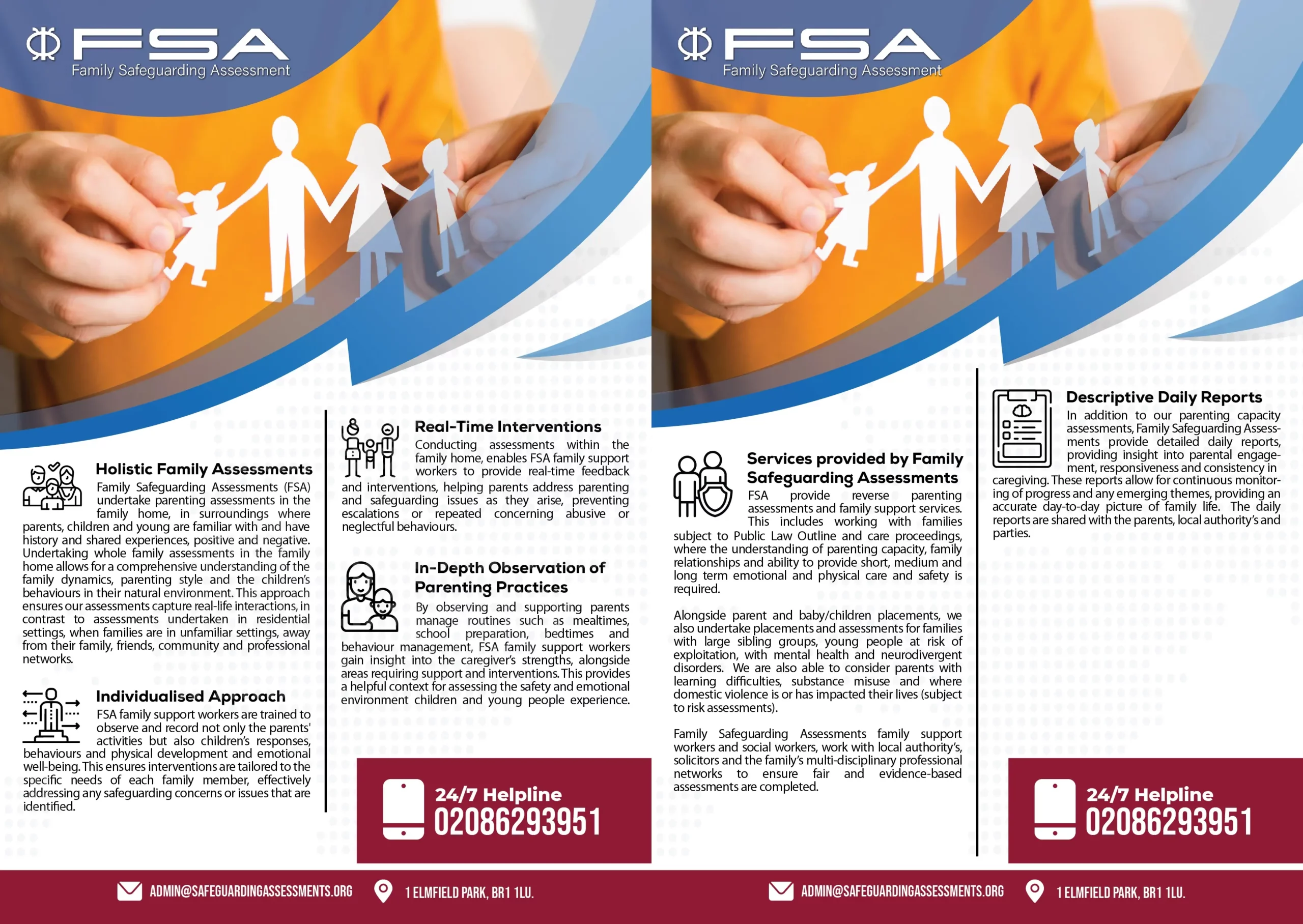
Family Safeguarding Assessments provides reverse parenting assessments in the family home, allowing professionals to assess parenting within the family’s normal environment where this is appropriate to the circumstances.
A home-based approach may allow the assessment to consider everyday routines, parent-child interactions, supervision, communication and practical care within the environment where family life normally takes place.
When comparing quotations, it is important to understand exactly what is included.
Depending on the assessment, the fee may cover professional activities such as:
However, the exact scope will vary between providers and types of assessment.
A low initial quotation may not necessarily represent the lowest overall cost if important parts of the assessment are excluded or charged separately.
For this reason, professionals should ask the provider to clarify what the quoted fee covers.
Before instructing a provider, it can be helpful to ask a few practical questions.
Ask who will actually undertake the assessment and what their qualifications and relevant experience are.
The person carrying out the assessment should have appropriate expertise for the issues raised in the referral.
Ask whether the quoted fee includes document review, meetings, observations, professional liaison, analysis and the final report.
This helps ensure that different providers are being compared on a similar basis.
The expected duration should be clear.
Some assessments may be relatively focused, while others require sustained observation over a longer period.
The timescale should reflect the questions being assessed rather than being based solely on cost.
The final report is an important part of the assessment process.
Ask whether preparation of the final report and professional analysis are included within the quoted fee.
For more information about reporting in proceedings, read our guide to parenting assessments and family court.
It is reasonable to ask whether there could be additional charges for matters such as travel, additional assessment work, extra observations or significant changes to the scope of the instruction.
Clear information at the beginning can reduce the risk of unexpected costs later.
Not necessarily.
The cost of an assessment should not be the only factor considered when choosing a provider.
An assessment should be appropriate to the questions being asked and carried out by suitably qualified professionals using a clear and defensible methodology.
A very low-cost assessment may not provide the level of observation, analysis or professional input required for a complex case.
Equally, a higher fee does not automatically mean that an assessment will provide better evidence.
Professionals should consider:
The most appropriate assessment is one that is properly matched to the circumstances of the family and the questions that need to be answered.
There is no universal price for a reverse parenting assessment because the assessment model can vary depending on the family and referral.
A reverse parenting assessment may involve professionals working within the family home and observing parenting over a sustained period.
Factors that may influence the cost include:
Where a 24-hour or highly intensive assessment model is required, the professional staffing and level of observation will also need to be considered when calculating the fee.
The best approach is therefore to provide the assessment provider with the referral details and request a case-specific quotation.
Perinatal parenting assessments can also vary in cost depending on the circumstances.
A pre-birth assessment may involve working with a parent during pregnancy, while a mother-and-baby or parent-and-baby assessment may involve observing care and the developing parent-child relationship following birth.
The assessment may consider areas such as:
Because the circumstances can vary significantly, a provider should review the referral before confirming the appropriate assessment structure and fee.
Yes.
Local authorities can provide the relevant referral information and ask an independent provider to confirm whether the assessment can be undertaken and what it would cost.
The provider may need information about:
Providing sufficient information at the referral stage can help the provider determine whether the proposed assessment is appropriate and what resources may be required.
Urgent assessments can require providers to work within a shorter timeframe than a standard referral.
This may affect the resources needed to arrange the assessment, review documents, conduct observations and prepare the report within the required deadline.
The provider should first establish whether the requested timetable is realistic.
Important information for an urgent referral may include:
Family Safeguarding Assessments considers urgent and emergency referrals where circumstances require a faster response, subject to the nature of the referral and available resources.
When comparing providers, avoid looking at the headline price alone.
Instead, compare what each provider is actually offering.
Who will carry out the assessment and what relevant experience do they have?
Does the proposed assessment answer the questions that need to be addressed?
How much direct observation and other evidence will be considered?
Does the provider have appropriate experience with the safeguarding concerns involved?
What will be included in the final report?
Can the provider complete the assessment within the required timetable?
Does the quotation clearly explain what is included and whether additional charges could arise?
This approach makes it easier to compare providers based on value and suitability rather than price alone.
The more clearly the provider understands the referral, the easier it is to determine the appropriate assessment approach.
When requesting a quotation, consider providing:
Not every provider will require all of this information before giving an initial indication, but the assessment scope should be clarified before the work begins.
An independent parenting assessment may contribute important information to decisions about a child’s care.
The purpose is not simply to produce a report at the lowest possible cost.
The assessment should provide relevant, reliable and clearly analysed evidence about the questions identified in the referral.
Choosing a provider solely because they offer the cheapest quotation may create problems if the assessment does not provide sufficient observation, analysis or professional expertise for the case.
On the other hand, paying more does not automatically guarantee a better assessment.
The best choice is usually the provider whose qualifications, methodology, availability and resources are appropriate to the individual referral.
Family Safeguarding Assessments provides independent parenting and family safeguarding assessments for local authorities, solicitors, children’s guardians and other professionals involved in family proceedings.
Our services include:
Our assessments are designed around the circumstances of each family and the questions that need to be addressed.
FSA works with qualified Independent Social Workers and Family Support Workers, with professional oversight from an experienced Consultant Social Worker.
Where appropriate, assessments can involve direct observation within the family home, allowing parenting to be considered in the environment where everyday family life takes place.
If you are considering an independent parenting assessment, contact Family Safeguarding Assessments with the referral details and required timescale to discuss the appropriate assessment approach and obtain a case-specific quotation.
There is no single price for every independent parenting assessment. The cost depends on factors such as the type and duration of the assessment, complexity of the case, level of observation, location, professional input and required timescale.
Every referral is different. The amount of professional time required can vary depending on the assessment questions, number of children, safeguarding concerns, documentation, observations and reporting requirements.
Not necessarily. The cost depends on the assessment structure, duration, staffing, location and level of observation required.
There is no universal price. A reverse parenting assessment may involve sustained observation and support within the family home, so the cost will depend on the duration, staffing, complexity and requirements of the individual referral.
Yes. Local authorities, solicitors and other professionals can provide referral information to an assessment provider and request a case-specific quotation.
This depends on the provider and the type of assessment. It is important to confirm exactly what is included in the quotation before instructing the provider.
An urgent assessment may require additional resources because the provider has to work within a shorter timeframe. However, the impact on cost depends on the individual referral and requirements.
Not necessarily. Cost should be considered alongside professional qualifications, relevant experience, assessment methodology, safeguarding expertise, reporting quality and the provider’s ability to meet the required timescale.
The cost of an independent parenting assessment depends on the individual circumstances of the referral.
Rather than looking for a single standard price, professionals should consider what the assessment needs to achieve, how much evidence needs to be gathered, the level of observation required and the expertise needed to answer the referral questions.
When comparing providers, look beyond the headline fee. Ask what is included, who will carry out the assessment, what methodology will be used, how the findings will be reported and whether the provider can meet the required timetable.
The right assessment should provide appropriate, evidence-based information about parenting capacity while keeping the child’s needs and safety at the centre of the process.
Contact Family Safeguarding Assessments to discuss your referral, assessment requirements and timescale and request a case-specific quotation.
At Family Safeguarding Assessments (FSA), we understand the importance of keeping families together while ensuring the safety and well-being of children