When making a parenting assessment referral, providing clear and relevant information at the outset can help an independent assessment provider understand the family’s circumstances, identify the work required and determine whether the assessment can be completed within the necessary timescale.
For local authorities, solicitors, children’s guardians and other professionals, the referral is an important first step in arranging an independent parenting assessment.
A referral should explain why the assessment is required, what concerns need to be explored, what information is already available and what the assessment is expected to establish. It should also identify any relevant court directions, safeguarding considerations and deadlines.
Not every case requires the same documents or assessment approach. The information needed will depend on the type of assessment, the child’s circumstances, the issues being considered and the requirements of the referring professional.
This guide explains what to include in a parenting assessment referral, which documents may be useful, how to communicate the assessment requirements and what professionals should clarify before instructing a provider.
A parenting assessment referral is a request for a suitably qualified professional or independent provider to assess a parent’s ability to meet their child’s needs.
Referrals may be made by local authorities, solicitors, children’s guardians and other professionals involved in safeguarding or family proceedings.
The assessment may consider parenting capacity, the parent’s understanding of safeguarding concerns, the quality of parent-child interactions, the ability to provide safe care and the potential for meaningful change.
Depending on the case, the referral may request a conventional parenting capacity assessment, a reverse parenting assessment conducted in the family home, or a perinatal assessment involving an unborn baby or a newborn.
The referral should make clear what type of assessment is being requested and why it is considered appropriate.
A provider may need to clarify the scope before confirming availability, timescales and the proposed assessment arrangements.
The first step is to explain the purpose of the referral.
The provider needs to understand the circumstances that have led to the assessment being requested and the decisions the findings may help inform.
For example, the assessment may be required to explore:
The referral should distinguish between established information, reported concerns and issues that still require assessment.
Providing a clear background helps the assessor understand the context without assuming that every allegation or concern has already been established.
It is also helpful to explain how the assessment relates to the wider safeguarding plan or family court proceedings, where applicable.
The assessment must be considered in the context of the individual child’s needs.
Information about the child or children helps the provider understand what the parent needs to demonstrate and which aspects of parenting are particularly important.
Relevant information may include:
For a baby or very young child, information about feeding, sleep, supervision, health and developmental needs may be particularly relevant.
For an older child, the assessment may need to consider emotional wellbeing, boundaries, education, behaviour, communication and age-appropriate independence.
Where several children are involved, the referral should identify their individual needs rather than treating the children as a single group. A parent’s ability to meet one child’s needs does not automatically establish that the same arrangements will meet the needs of every sibling.
A useful referral identifies the specific concerns the assessment needs to explore.
Broad descriptions such as “parenting concerns” may not provide enough detail for a provider to determine the appropriate assessment approach.
Where relevant, explain the nature of the concerns, the circumstances in which they arose and any information available about their impact on the child.
Areas for assessment may include:
The referral should also identify the parent’s strengths, any progress already demonstrated and support that has been effective.
A balanced account helps the assessor understand the whole family situation and avoids framing the assessment solely around difficulties.
Clear assessment questions are among the most important elements of a referral.
The provider should understand what the assessment is expected to examine, rather than being asked simply to decide whether someone is a suitable parent.
Depending on the case, the questions may address whether a parent can:
The questions should be relevant to the individual family and the purpose of the assessment.
Where a solicitor or local authority is working to a Letter of Instruction or specific court directions, these should be supplied and the provider should clarify any uncertainties before the assessment begins.
It is important to distinguish the questions that the assessment can reasonably address from matters that fall outside its scope.
Where the referral relates to family court proceedings, the provider should receive the relevant instructions and court documents needed to understand the assessment requirements.
Depending on the case, these may include:
Not every document will be necessary for every referral. The provider should be given the information relevant to the assessment and its intended purpose.
The deadline should be stated clearly. If the report is required for a hearing or another significant decision, explain the date and any relevant milestones.
A provider can then consider whether the requested assessment is feasible within the available time.
Where formal expert evidence is being sought, the parties should also clarify the nature of the instruction and any applicable court requirements. An independent assessment should not automatically be described as expert evidence without considering its actual status and purpose.
For further context, read our guide to parenting assessments and family court.
Previous assessments and professional records can provide important context, particularly where concerns have developed over time.
Depending on the referral, useful documents may include:
The aim is not to assume that an earlier assessment reached the correct conclusion or that its findings remain unchanged.
Instead, the information can help the assessor understand the family’s history, identify issues requiring further exploration and consider whether the parent’s circumstances or behaviour have changed.
If a previous assessment identified particular concerns, it may be helpful to explain which issues remain unresolved and which changes need to be evaluated.
Only relevant information should be shared, using appropriate professional and information-governance procedures.
The referral should state whether a conventional parenting capacity assessment, reverse parenting assessment, perinatal assessment or another type of assessment is being considered.
Different approaches involve different methods of gathering evidence.
A parenting capacity assessment examines a parent’s ability to meet their child’s needs safely. Depending on the referral, it may involve interviews, observations, document review and analysis of relevant professional information.
A reverse parenting assessment involves assessing the family within the home rather than requiring the family to live in a residential assessment setting.
This approach may allow professionals to observe everyday parenting, routines and parent-child interactions in the family’s usual environment, where appropriate.
The referral should explain why a home-based approach is being considered and identify any practical or safeguarding requirements.
A perinatal assessment considers parenting capacity during pregnancy and/or the early stages of a baby’s life.
The referral may need to include information about the expected birth date, relevant safeguarding concerns, plans for the baby’s care and the timescales for any pre-birth or post-birth assessment.
The appropriate approach will depend on the individual circumstances and the questions that need to be answered.
Practical information about the family can help the provider assess whether the proposed arrangements are suitable.
Where relevant, the referral should explain:
This information is particularly important when the assessment will take place in the family home.
For example, the presence of other household members, the availability of a suitable observation environment or the need to coordinate with other professionals may affect how the assessment is planned.
The referral should identify known risks clearly so that appropriate arrangements can be considered before work begins.
Safeguarding information should be shared clearly and promptly.
The provider needs to understand any known risks that could affect the child, parent, assessor or other professionals involved in the assessment.
Depending on the case, this may include information about:
The referral should distinguish between current and historical concerns and identify any immediate safety measures that are already in place.
If circumstances change after the referral has been submitted, the provider should be informed promptly.
The assessment provider can then consider whether the proposed approach remains appropriate and what arrangements may be required.
A provider needs to know when the assessment should begin and when the findings are required.
The referral should specify:
An urgent referral should explain why the assessment cannot follow a standard timetable.
However, a short deadline does not automatically mean that a comprehensive assessment can safely or appropriately be completed within that period.
The provider should consider the work required, the information available, professional availability and the time needed for observation and analysis.
Family Safeguarding Assessments considers urgent and emergency referrals, subject to availability and the nature of the assessment required. Confirm the current referral process and response-time commitments directly with FSA before relying on a specific turnaround time.
Before the assessment begins, the referring professional and provider should establish what the final report is expected to cover and how communication will be managed.
Useful points to clarify include:
Where several agencies are involved, it is helpful to identify the appropriate contacts and clarify their roles.
Clear arrangements can reduce delays and help ensure that the assessor receives relevant information as the assessment progresses.
The provider should also explain any limitations that become apparent during the assessment, including where the available evidence does not allow a particular question to be answered fully.
For additional guidance, see what a parenting assessment report tells the family court.
Before submitting a referral, use this checklist to confirm that the essential information has been considered.
Not every item will apply to every referral. The provider can advise which additional information is needed once the initial request has been reviewed.
Once the referral has been received, the provider will generally review the information to determine whether the proposed assessment is appropriate and whether it can be undertaken within the required timescale.
The next steps may include:
The precise process will depend on the type of assessment, the family circumstances and any relevant court directions.
Providing clear information at the beginning can help reduce avoidable delays, although the provider may still need further information as the work progresses.
A referral does not need to be unnecessarily long, but it should be sufficiently clear for the provider to understand the work being requested.
Common problems include:
A request to assess whether someone is a “good parent” does not identify the specific issues that need to be explored.
Better approach: Set out the questions in terms of the child’s needs, the identified concerns and the parenting abilities that require assessment.
Failing to provide hearing dates or the report deadline can make it difficult to determine whether the requested timetable is realistic.
Better approach: Include all relevant dates and explain any urgent requirements.
A referral may provide a list of concerns without explaining their context or the family’s history.
Better approach: Supply a concise, relevant summary and the key supporting documents.
Known risks may be described vaguely or omitted from the initial referral.
Better approach: Clearly identify relevant risks, distinguish current concerns from historical information and explain any safety arrangements already in place.
The referring professional may request a report without specifying the questions, type of assessment or expected outcome.
Better approach: Clarify the purpose, assessment method and reporting requirements before the work begins.
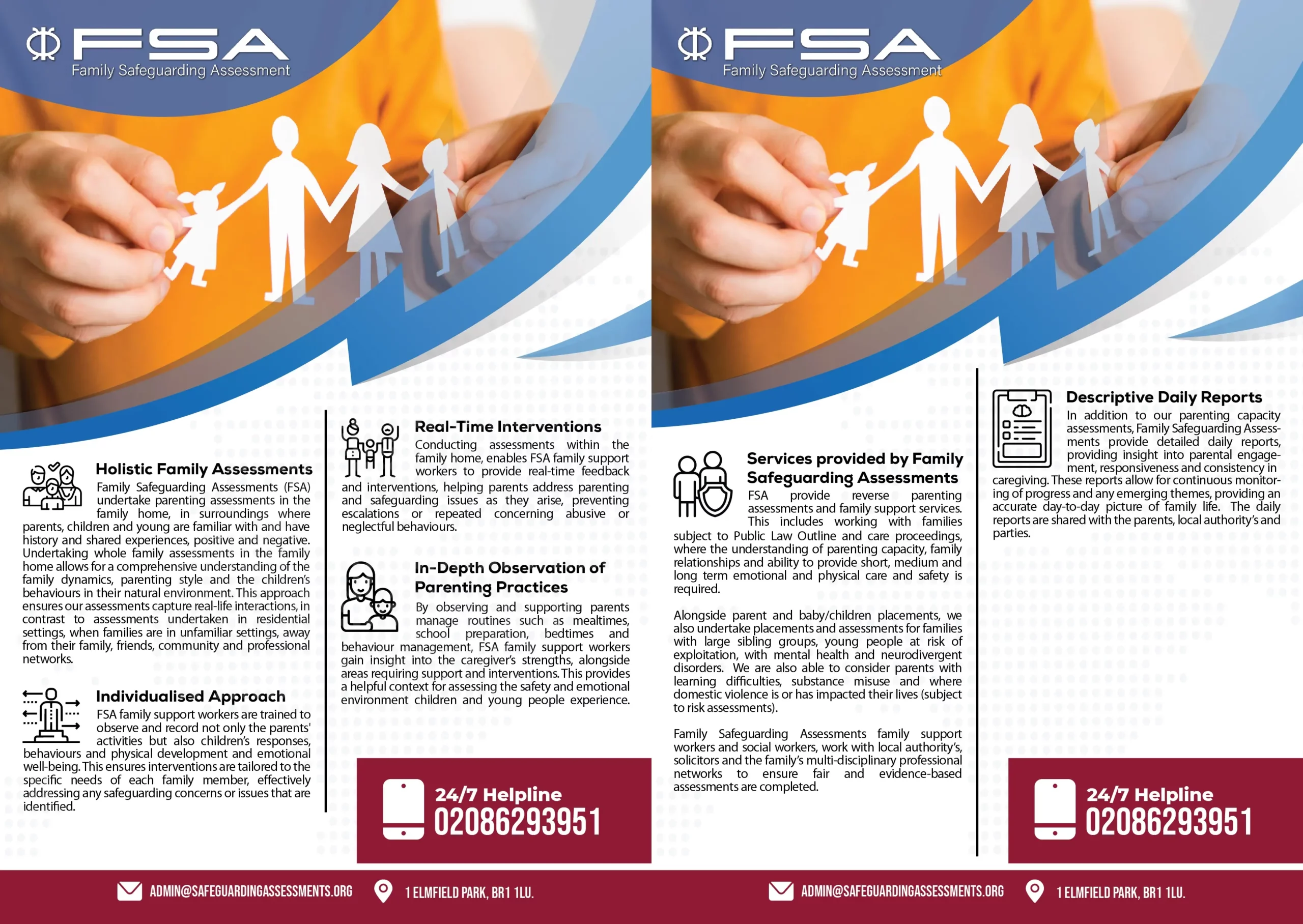
Family Safeguarding Assessments works with local authorities, solicitors, children’s guardians and other professionals who require independent parenting and family safeguarding assessments.
Its services include:
FSA’s Consultant Social Worker reviews new referrals. Confirm current availability and response times directly with the team when submitting an enquiry.
To help the team review a referral, professionals should provide the assessment purpose, relevant background information, key documents, specific questions and required timescale.
If some information is not yet available, explain what is outstanding rather than delaying an initial enquiry unnecessarily.
Contact Family Safeguarding Assessments to discuss the referral requirements and whether the proposed assessment is appropriate for the case.
Referrals may be made by local authorities, solicitors, children’s guardians and other professionals involved in safeguarding or family proceedings. The appropriate referral route depends on the service and circumstances.
Depending on the case, documents may include a Letter of Instruction, relevant court directions, previous assessments, safeguarding plans, case summaries and other records necessary to understand the family circumstances and assessment questions.
Not necessarily. The documentation required depends on the type of assessment and the circumstances of the referral. Where a formal Letter of Instruction or court directions apply, these should be provided and clarified with the provider.
Questions should focus on the child’s needs, the parenting concerns that require assessment, the parent’s understanding of safeguarding issues and any relevant capacity for change. The questions should be specific to the individual case.
You can enquire about an urgent referral, but the provider will need to consider availability, the scope of the assessment, the information available and the requested deadline before confirming whether the work can be undertaken.
An initial enquiry may be possible before every document has been gathered. However, the provider will need sufficient information to understand the proposed assessment and may require additional documents before confirming the scope or starting work.
The provider may contact the referring professional to clarify the questions, request relevant documents, discuss safeguarding considerations or agree practical arrangements before proceeding.
The start date depends on the provider’s availability, the assessment type, the complexity of the referral and whether the necessary information is available. Any court deadlines should be provided at the earliest opportunity.
A clear parenting assessment referral gives the provider a better understanding of the family, the concerns that need to be explored and the evidence required to address the assessment questions.
For local authorities, solicitors and other professionals, the most useful referrals combine a concise background summary with specific assessment questions, relevant documents, clear safeguarding information and realistic timescales.
Not every referral needs every document listed in this guide. The aim is to provide enough relevant information for the provider to determine the appropriate assessment approach and identify any gaps that need to be addressed.
By clarifying the purpose, scope and practical requirements at the outset, professionals can help establish a more focused assessment process centred on the child’s needs and safety.
Contact Family Safeguarding Assessments to discuss the circumstances of the case, the information available and the assessment requirements.
At Family Safeguarding Assessments (FSA), we understand the importance of keeping families together while ensuring the safety and well-being of children