Choosing an independent parenting assessment provider is an important decision for solicitors, local authorities, children’s guardians and other professionals involved in family proceedings.
The quality of an assessment depends not only on the qualifications of the individual assessor, but also on whether the provider understands the purpose of the referral, can work within the required timescale, has appropriate safeguarding experience and can produce clear, evidence-based findings.
An independent parenting assessment should not be viewed simply as a report-writing exercise. It should provide a structured assessment of parenting capacity in the context of the individual child, family circumstances and concerns that need to be addressed.
For professionals commissioning an assessment, the question is therefore not simply, “Who can complete a parenting assessment?” but rather, “Which provider is appropriately qualified, independent, responsive and able to answer the questions this case requires?”
An independent parenting assessment provider is a professional or organisation that carries out an assessment of a parent’s ability to meet the needs of their child.
The assessment may consider areas such as parenting capacity, safeguarding, parent-child relationships, understanding of concerns, ability to respond to a child’s needs and capacity for change. Learn more about the scope of parenting capacity assessments.
Depending on the circumstances, the assessment may involve direct observation, discussions with parents, consideration of professional information and review of relevant records or previous assessments.
It is important to establish exactly who will carry out the assessment and what professional role they will have.
An independent social worker, for example, may undertake an assessment independently of the local authority. However, working independently does not automatically mean that the person is acting as an expert witness. Where an assessment is intended to provide expert evidence, the requirements of the relevant court proceedings and directions must be considered.
A good provider should be able to explain clearly:
Whether the proposed assessment is appropriate for the questions in the case
Qualifications are an essential starting point, but they should not be the only consideration.
When choosing a parenting assessment provider, ask who will actually undertake the assessment and whether they have relevant experience in safeguarding, child protection, parenting capacity and family proceedings.
Relevant experience may include:
The assessor’s professional background should match the questions the assessment needs to answer.
A provider may have considerable general experience, but that does not necessarily mean they are the right fit for every referral. A case involving domestic abuse, for example, may require a different area of expertise from a case where the primary concern relates to neglect or a parent’s ability to understand their child’s additional needs.
It is also worth establishing whether the assessment will be carried out by a registered social worker, independent social worker or another appropriately qualified professional, and who will have responsibility for reviewing and signing off the final report.
Family Safeguarding Assessments works with qualified professionals, including Independent Social Workers and Family Support Workers, with oversight from experienced social work professionals.
Independence is particularly important where an assessment may be relied upon by several professionals or considered within family proceedings.
An independent assessment should be approached objectively rather than with a predetermined conclusion.
The assessor should be able to consider both strengths and areas of concern, weigh different sources of evidence and explain how the evidence supports their findings.
Before instructing a provider, consider asking:
Independence does not mean that an assessment will necessarily be positive or negative for a parent. It means that the assessment should be based on the evidence gathered and the professional analysis of that evidence.
A balanced assessment can provide a clearer picture of a parent’s strengths, difficulties, risks and ability to make and sustain meaningful changes.
A parenting assessment should be based on appropriate evidence rather than a single conversation or brief impression.
Depending on the referral, evidence may include:
The precise methodology should depend on the questions that the assessment needs to answer.
For example, observing a parent interacting with their child can provide information about communication, responsiveness, boundaries, supervision and the parent’s ability to recognise and respond to the child’s needs.
The setting may also influence what can be observed. In appropriate circumstances, a home-based assessment can provide an opportunity to observe parenting within the family’s ordinary environment and routines.
For reverse parenting assessments in particular, sustained observation and support within the family home may provide useful information that cannot always be obtained through a short or highly structured assessment.
One of the most important parts of commissioning an assessment is making sure the purpose and scope are clear from the beginning.
A parenting assessment should not simply provide a generic description of a parent’s abilities. It should address the specific issues relevant to the child and the proceedings.
Depending on the case, the assessment may need to consider:
The provider should understand the referral information, Letter of Instruction and any relevant court directions before confirming the assessment approach.
Clear questions also help prevent an assessment from becoming unnecessarily broad or failing to address the issues that matter most to the case.
Timescales are often an important consideration in family proceedings.
Before instructing a provider, establish:
A provider should be realistic about availability rather than agreeing to a deadline that cannot reasonably be achieved.
This is particularly important where an assessment is required to inform decisions about a child’s future care arrangements.
Family Safeguarding Assessments can consider urgent and emergency referrals where circumstances require a faster response, subject to availability and the nature of the assessment required.
Safeguarding should be central to a parenting assessment where there are concerns about a child’s welfare.
The provider should be able to demonstrate an understanding of the safeguarding issues relevant to the referral.
Depending on the circumstances, these may include:
The assessment should not focus exclusively on difficulties.
Understanding protective factors can also be important. For example, a parent may have developed a support network, engaged with services, demonstrated improved understanding of safeguarding concerns or made changes to their behaviour.
The important issue is whether the evidence demonstrates meaningful and sustainable change and whether the child’s needs can be safely met. Read more about safeguarding concerns during a parenting assessment.
Before instructing a provider, it is reasonable to ask what the final report will cover.
The exact format will depend on the purpose and scope of the assessment, but a comprehensive report may include:
A useful parenting assessment report should distinguish between information obtained, observations made and professional analysis.
The report should also explain the reasoning behind its conclusions. Simply stating that a parent is or is not capable of meeting a child’s needs provides limited value if the evidence and reasoning supporting that conclusion are not clear.
For professionals making decisions about a child, the report should therefore provide a clear connection between the evidence gathered, the analysis undertaken and the conclusions reached.
Family court proceedings can involve different types of professional evidence, and it is important to establish what role the assessment is intended to play.
An independent social worker is not automatically an expert witness simply because they work independently.
Where an individual is instructed to provide expert evidence, the relevant court rules, directions and requirements must be followed.
Professionals commissioning an assessment should therefore clarify:
A reputable provider should be transparent about what it can provide and should not present a standard parenting assessment as something different from the service actually being commissioned.
For additional context, see our guide to parenting assessments and family court proceedings.
The setting in which an assessment takes place can influence the evidence available to the assessor.
Some assessments may be appropriate in a family home, while others may require a different environment depending on the circumstances, safeguarding considerations and purpose of the assessment.
A home-based assessment may allow the assessor to observe:
However, a home-based assessment will not necessarily be appropriate for every family.
The provider should consider the level of risk, the child’s circumstances, the purpose of the assessment and whether the proposed environment allows the necessary evidence to be gathered safely and appropriately.
The setting should therefore be determined by the needs of the individual case rather than treated as a standard feature of every assessment.
Communication can make a significant difference to the assessment process, particularly where several professionals are involved.
Before commissioning an assessment, you should be able to obtain clear information about:
Clear communication at the referral stage can help avoid misunderstandings later.
This is particularly important for urgent referrals or cases where local authorities, solicitors, guardians and other professionals need to coordinate information within a defined timetable.
A provider should also be clear about what the assessment can and cannot establish. No assessment can answer questions that fall outside its professional scope or that cannot reasonably be addressed through the available evidence.
Before instructing an independent parenting assessment provider, consider the following checklist.
There is no single assessment approach that is suitable for every family.
The right provider will depend on the questions that need to be answered, the child’s circumstances, the safeguarding concerns, the required timescale and the type of assessment being requested.
For example, a conventional parenting capacity assessment may be appropriate for one referral, while another case may require a reverse parenting assessment involving observation within the family home.
The key is to choose a provider whose professional experience, assessment methodology and available resources match the requirements of the individual case.
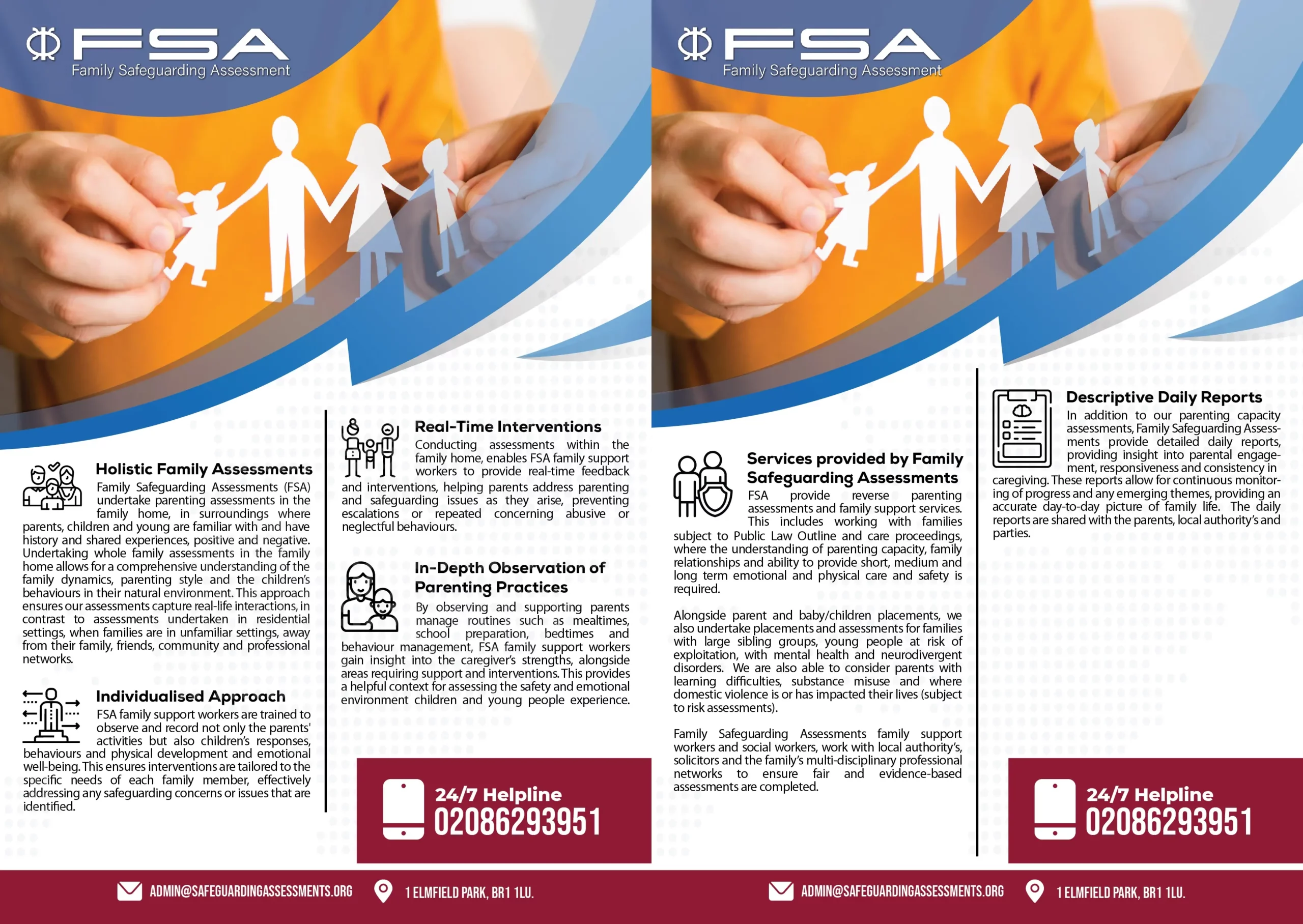
Family Safeguarding Assessments provides independent parenting and family safeguarding assessments for local authorities, solicitors, children’s guardians and other professionals involved in child and family proceedings.
Our assessment services include parenting capacity assessments, reverse parenting assessments and supervised contact services.
Each referral should be considered in the context of the individual family, the child’s needs and the specific questions that need to be addressed.
Our experienced professionals aim to provide structured, evidence-based assessments that give referring professionals a clearer understanding of parenting capacity, safeguarding concerns, strengths, risks and potential areas of change.
If you are considering an independent parenting assessment, contact Family Safeguarding Assessments to discuss the referral, assessment requirements and available options.
An independent parenting assessment provider is a professional or organisation that carries out an assessment of parenting capacity independently of the organisation that may have been involved in the family’s previous assessment or social work.
The assessment considers the specific questions identified in the referral and may involve interviews, observations, records and information from relevant professionals.
Consider the assessor’s qualifications, relevant safeguarding and family experience, independence, assessment methodology, reporting approach, availability and ability to meet the requirements of the individual case.
The provider should also be able to explain clearly who will carry out the assessment and how the findings will be reached.
Yes. Independent providers can undertake parenting assessments for local authorities where the assessment is appropriate to the referral and the provider has the necessary expertise and availability.
The scope, purpose and timescale should be agreed before the assessment begins.
Yes. Solicitors may instruct an independent provider where an assessment is appropriate to the case and the requirements of the proceedings.
The instruction should clearly identify the purpose and questions that the assessment needs to address.
No. An independent social worker is not automatically an expert witness simply because they work independently.
Whether an individual is providing expert evidence depends on the nature of their instruction and the requirements of the relevant proceedings. You can read more about the role of an independent social worker in parenting assessments.
In appropriate circumstances, yes.
A home-based assessment can allow the assessor to observe parenting within the family’s normal environment. However, the suitability of a home-based assessment depends on the circumstances, safeguarding considerations and questions that need to be addressed.
The contents will depend on the purpose and scope of the assessment. A report may include the instructions, background information, evidence considered, methodology, observations, strengths, concerns, safeguarding considerations, analysis, parenting capacity, capacity for change and recommendations where appropriate.
Choosing an independent parenting assessment provider is about finding the right professional fit for the individual case.
Qualifications and experience are important, but professionals should also consider independence, evidence gathering, safeguarding expertise, reporting standards, communication and timescales.
The most important question is whether the provider can carry out the appropriate assessment, answer the relevant questions and explain its findings through a clear and transparent evidence base.
A well-planned assessment can help professionals develop a clearer understanding of parenting capacity while keeping the child’s needs, welfare and safety at the centre of the process.
Contact Family Safeguarding Assessments to discuss your referral, assessment requirements and available options
At Family Safeguarding Assessments (FSA), we understand the importance of keeping families together while ensuring the safety and well-being of children