When a local authority or solicitor commissions an independent parenting assessment, one of the first questions is often how long the process will take.
Timescales matter because assessment findings may help professionals understand a parent’s capacity to meet a child’s needs, identify support requirements and inform decisions about future care arrangements. Where family court proceedings are ongoing, the assessment may also need to fit within specific deadlines.
However, there is no single timescale that applies to every parenting assessment. The time required depends on the complexity of the case, the questions being asked, the assessment method, the availability of relevant records and the arrangements needed to complete the work.
This guide explains what can affect the duration of an independent parenting assessment, how professionals can help avoid unnecessary delays and what to consider when requesting a referral.
The time required for a parenting assessment varies according to the circumstances of the family and the scope of the assessment.
A straightforward assessment with a clearly defined purpose, readily available records and good cooperation may be completed more quickly than a complex assessment involving multiple children, significant safeguarding concerns or several professionals.
It is important to distinguish between the time spent actively undertaking an assessment and the overall period from referral to delivery of the final report. These are not necessarily the same.
The overall process may include:
When requesting a quote or making a referral, professionals should ask the provider to confirm the anticipated start date, expected duration and report deadline for the particular case.
For more information about the factors that can influence the fee, read our guide to how much an independent parenting assessment costs.
Several factors can influence how long an assessment takes. Understanding these at the referral stage can help professionals establish realistic expectations.
The level of complexity is one of the main considerations.
An assessment involving a clearly defined set of questions may require a different approach from one involving longstanding safeguarding concerns, several children, disputed information or multiple areas of parenting capacity.
The assessor must have sufficient relevant information to understand the family’s circumstances and consider the evidence against the child’s needs.
Where additional issues emerge during the assessment, the scope or timetable may need to be reviewed.
A clearly defined assessment scope helps the provider plan the work.
For example, a referral may focus on a parent’s ability to provide consistent care and respond to a child’s developmental needs. Another may require a broader examination of parenting capacity in the context of complex safeguarding concerns.
The number and nature of the questions can affect the interviews, observations, records and professional information that need to be considered.
Professionals should explain the concerns that prompted the referral and identify the specific questions the assessment is expected to address.
An assessment may be delayed if important documents are missing or arrive late.
Depending on the case, relevant information may include:
Only information relevant to the assessment should be requested and shared, with appropriate regard to confidentiality and data protection.
Providing the available documents at the referral stage can help the assessor understand the background and identify any gaps early.
Parenting assessments may involve interviews, home visits, observations and discussions with relevant professionals, depending on the agreed scope.
Arranging these activities can take time, particularly when several people need to be involved or when there are practical barriers to attendance.
Clear communication about availability, contact arrangements and any accessibility requirements can help prevent avoidable delays.
If appointments need to be rearranged, the provider and referring professional should communicate promptly and consider the impact on the agreed deadline.
The setting and method of assessment can also affect the timetable.
Some assessments may involve visits to a parent’s home or observation of family routines. Others may require arrangements for observing parent-child interactions in a suitable setting.
The approach should be appropriate to the assessment questions and the family’s circumstances. It should not be rushed simply to meet a deadline if doing so would compromise the quality or completeness of the work.
Where a home-based or reverse parenting assessment is being considered, professionals should clarify the proposed arrangements with the provider rather than assume that every assessment follows the same timetable.
Some assessments require information from several professionals to provide a fuller understanding of the family’s circumstances.
This may involve obtaining relevant records, clarifying previous concerns or considering information from health, education or social care services.
Delays in receiving essential information can affect the completion date. At the same time, the assessor should be clear about which information is necessary and whether outstanding material prevents the assessment from being finalised.
The final report is an important part of the assessment process.
It should explain the assessment undertaken, the evidence considered, the parent’s strengths and difficulties, relevant safeguarding concerns and the analysis supporting the conclusions.
The time needed to prepare the report depends on the scope and complexity of the work. Appropriate review and quality assurance should also be factored into the agreed timetable.
A short report is not necessarily a better report. The priority is to produce a clear, proportionate and evidence-based account that answers the questions set out in the referral.
An urgent assessment may be possible, depending on the provider’s availability, the scope of the work and the deadline required.
However, urgency does not automatically mean that an assessment can be completed within a particular number of days. The provider needs to understand the case before confirming whether the requested timescale is realistic.
When requesting an urgent assessment, professionals should explain:
The provider can then consider availability and clarify what can reasonably be achieved within the requested period.
Where a court deadline applies, professionals should raise it at the outset. Any change to a court-ordered timetable must be managed through the appropriate process rather than assumed to be acceptable.
Although not every delay can be prevented, good preparation can make the process more efficient.
A referral should explain why the assessment is needed and what the assessor is expected to examine.
Vague instructions can lead to further questions and uncertainty about the scope of the work.
Our guide to parenting assessment referral requirements explains what information professionals should consider including.
Provide the available background records, relevant court documents and previous assessment reports at the beginning of the process, where appropriate.
If important documents are outstanding, identify them clearly and explain when they are expected to be available.
Make sure the provider understands the required completion date and the reason for it.
If the assessment is intended to inform ongoing family court proceedings, share the relevant directions and clarify the date by which the report is needed.
Explain any arrangements that may affect scheduling, such as access to the family home, interpreter requirements, contact arrangements or the availability of relevant participants.
Addressing these matters early can reduce the likelihood of repeated rescheduling.
The referring professional and provider should agree how progress will be communicated and how any emerging issues will be handled.
If new information changes the assessment scope or makes the deadline difficult to achieve, the implications should be discussed as soon as possible.
Yes. Different assessment types may require different arrangements, depending on the purpose and complexity of the work.
A parenting assessment generally focuses on a parent’s capacity to meet a child’s needs and provide safe, appropriate care.
The duration depends on the questions, the evidence available and the assessment activities required.
A reverse parenting assessment may examine how a parent can care for a child within their own home environment, where appropriate to the case.
Practical arrangements, the assessment scope and the information required will influence the timetable. Professionals should discuss these details with the provider before confirming a deadline.
Perinatal assessments consider parenting in the context of pregnancy, childbirth or the early stages of a child’s life, depending on the service and the case.
The relevant questions, stage of pregnancy or the child’s age, safeguarding concerns and practical arrangements may all affect the work required.
You can find out more about perinatal assessments and the circumstances in which this type of assessment may be relevant.
Mother-and-baby assessments may require particular attention to the parent’s care of the baby, the baby’s developmental and practical needs, and any identified safeguarding concerns.
The duration depends on the agreed scope, the evidence required and the arrangements for carrying out the assessment safely and appropriately.
The name of the assessment alone is not enough to determine the timescale. The provider should confirm the anticipated timetable for the specific referral.
Sometimes an assessment cannot be completed within the original estimated period.
This may happen because essential records are delayed, appointments cannot be arranged, the assessment questions change or new information requires further consideration.
If a delay becomes likely, the provider and referring professional should clarify:
Where the assessment relates to court proceedings, any implications for the court timetable should be raised promptly and managed through the appropriate channels.
An assessment should not be treated as complete simply because the original deadline has arrived. The findings must be sufficiently supported by the evidence gathered, and any limitations should be made clear.
In family proceedings, the timing of a parenting assessment can be important because the findings may inform decisions about a child’s future care.
However, an assessment is only one part of the wider decision-making process. Its role depends on the questions being considered, the evidence already available and the directions made in the individual case.
Professionals should establish the report deadline before commissioning the work and ensure that the provider has the relevant court directions and background information.
It is also important to understand the distinction between a parenting assessment and formal expert evidence. If an assessment or proposed instruction involves expert evidence for court proceedings, the applicable procedural requirements must be followed.
For more information about the role of these assessments, see our guide to parenting assessments and family court.
Before commissioning an assessment, local authorities and solicitors may find it helpful to ask:
These questions help establish clear expectations and give the referring professional an opportunity to address potential obstacles before the assessment starts.
The provider should explain the proposed timetable in the context of the actual referral rather than offer a blanket guarantee that may not be appropriate for every case.
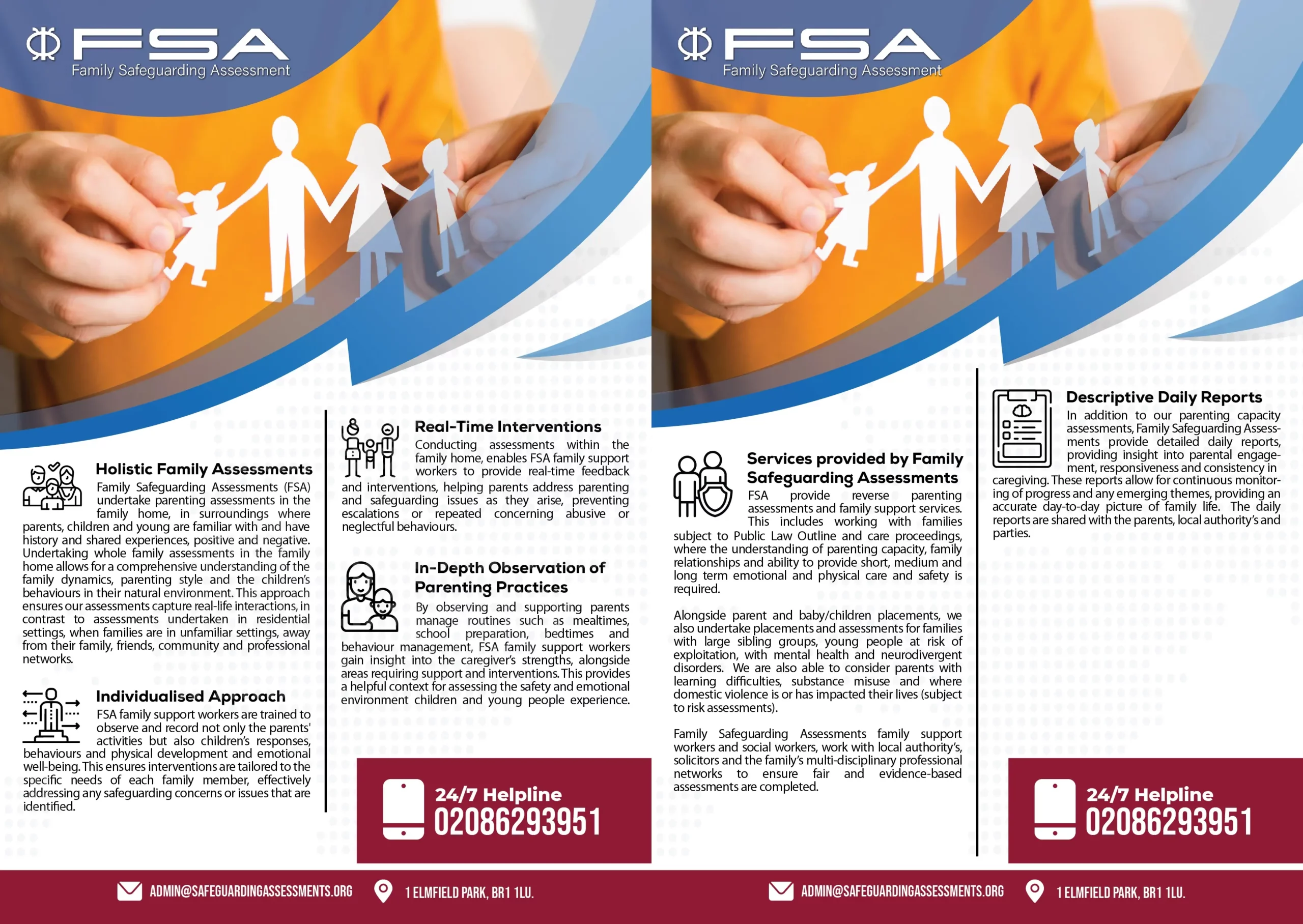
Family Safeguarding Assessments (FSA) provides independent parenting and family safeguarding assessment services for local authorities, solicitors, children’s guardians and other professionals involved in family cases.
Its services include parenting capacity assessments, reverse parenting assessments, perinatal assessments, mother-and-baby assessments and supervised contact services.
When discussing a referral, professionals should provide the purpose of the assessment, the relevant background information and any applicable deadline. This helps establish the proposed scope and allows the practical requirements and anticipated timescale to be discussed.
The duration of an assessment will depend on the individual circumstances, the work required and the provider’s availability. Any proposed start date and completion deadline should therefore be confirmed for the specific case.
To discuss a referral or assessment requirement, visit Family Safeguarding Assessments.
There is no single timescale that applies to every assessment. The duration depends on the scope, complexity, availability of relevant records, assessment arrangements and report requirements. Ask the provider to confirm the anticipated timetable for the specific case.
It may be possible, depending on the provider’s availability and the work required. The deadline should be shared at the referral stage so that the provider can consider whether the proposed timetable is realistic.
Common factors include incomplete records, unclear referral questions, difficulties arranging appointments, delays in obtaining relevant information and changes to the scope of the assessment.
Urgent work may affect the fee, depending on the provider’s arrangements and the resources required. Professionals should request a quote that clearly explains the proposed scope, fee and any additional costs. Read our guide to parenting assessment costs for further information.
No. The methods and setting depend on the purpose of the assessment, the questions being asked and the family’s circumstances. The proposed approach should be clarified with the provider before the assessment begins.
The scope or timetable may need to be reviewed if new information emerges. Any proposed changes should be discussed with the referring professional, with court deadlines and applicable requirements taken into account.
It is sensible to make contact as soon as the need for an assessment has been identified, particularly where court deadlines or other time-sensitive decisions apply. Early discussion can help clarify availability, the required documents and the anticipated timetable.
The time required for an independent parenting assessment depends on the questions being asked, the complexity of the case and the evidence and arrangements needed to complete the work.
Clear referral instructions, timely access to relevant records and early agreement about deadlines can help reduce avoidable delays. However, the assessment must still be sufficiently thorough to provide a reliable, evidence-based understanding of the parent’s capacity to meet the child’s needs.
For local authorities and solicitors, the best starting point is to discuss the individual referral with the provider, explain any court deadlines and agree a realistic timetable before the assessment begins.
Family Safeguarding Assessments works with local authorities, solicitors and other professionals to discuss independent parenting and family safeguarding assessment requirements.
Visit Family Safeguarding Assessments to learn more about its services or make an enquiry.
At Family Safeguarding Assessments (FSA), we understand the importance of keeping families together while ensuring the safety and well-being of children